
Moon's death threatens unity of Unification Church
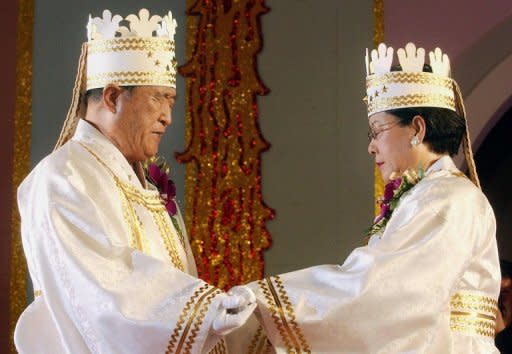

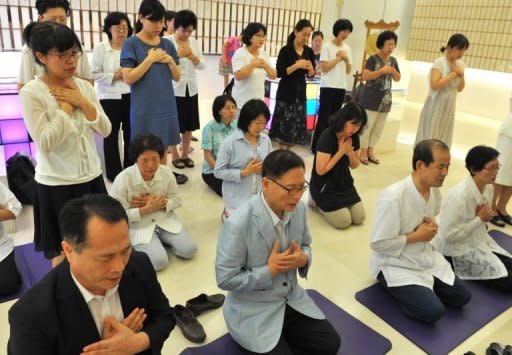
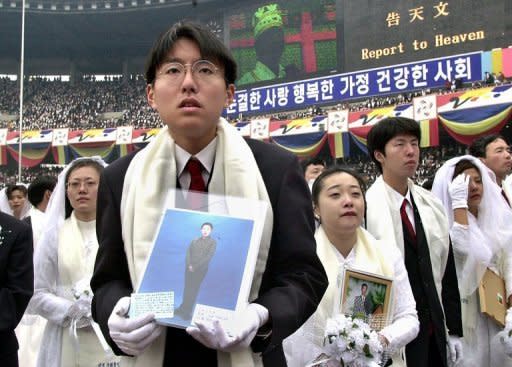
The death of Sun Myung Moon robs his Unification Church of the glue that sustained its global following as a cohesive religious and financial force even as membership dwindled from its 1980s peak, analysts say. A messianic movement built on the rubble of the Korean War and exported to countries such as the United States where it found favour with both conservatives and disaffected ex-hippies, the church now faces an uncertain future. While it claims a worldwide following of three million, experts suggest the core membership is far smaller although it still carries a commercial clout that allows the church to punch way above its doctrinal weight. The death of its charismatic founder on Monday at the age of 92 marks "an important turning point", according to Tark Ji-Il, professor of theology at Busan Presbyterian University. Without Moon's unifying presence, Tark and others see potential for conflict between his sons who control the church's religious and business arms and who do not command the same loyalty as their father from overseas chapters. "The brothers have their own followers, and you can't rule out the possibility that the church could end up divided depending on how they handle things," Tark said. While the media-coined "Moonie" moniker was intended to belittle, the fact remains that it was very much Moon's church -- founded, driven and maintained by the sheer force of his personality and the business acumen of loyal members. Founded in 1954 a year after the Korean War, the church, like all new religious movements, initially struggled to assert itself against the establishment. Mainstream Christian groups were particularly hostile, denouncing as heretical Moon's claim to have been personally chosen by Jesus. Moon's survival strategy, according to Kim Heung-Soo, professor of Korean Christianity at Mokwon University, was to avoid a doctrinal conflict and instead forge close ties with the military regime then ruling South Korea. "One way he did this was by promoting anti-communism as one of the church's major creeds," Kim said. "He used the same strategy when he moved to the US. He was a vocal proponent of the Vietnam War, hailing it as the war against communists, and publicly supported President Nixon during the Watergate scandal," he added. The timing of the church's expansion to the United States -- Moon moved there in 1972 -- was fortuitous for its growth, according to David Bromley, professor of religious studies at Virginia Commonwealth University "The counter-culture was breaking up, the Vietnam War was winding down and there were people spilling out of a variety of movements and looking for new options," Bromley said. Rapid recruitment saw the church's membership swell from an initial group of 100 missionaries to around 10,000 in just a few years. However, Bromley believes the church's influence was exaggerated, partly as a result of Moon's high-profile courtship of senior US political figures and also the accusations of widespread brainwashing levelled by the church's opponents. "The church claimed large numbers of members and opponents also came out with huge estimates because that made it seem more dangerous," Bromley said. "At one point, people were convinced there was a Moonie under every blanket, which obviously wasn't the case," he added. Where Moon's church had a real advantage was its cultivation of business-minded members -- particularly in the US and Japan -- who helped build it into a multi-billion dollar commercial empire. "It quickly became a business organisation as much as a religious one," said Tark. Towards the end of the 1980s, membership began to fall off as the result of various scandals and political and social changes in South Korea and elsewhere that clipped Moon's influence. "I believe that what really sustains the church now is cash from the Japanese faithful," said Tark who, like numerous other experts, believes Moon's most enduring legacy will be commercial rather than religious. "The problem with that, of course, is that the business doesn't need the church," said Bromley. "Before, the glue holding the global movement together was Moon with all the national chapters owing him tributes. "Now it's divided among his children. Will Japanese members continue to throw money to his sons, or will the national groups go their own way, or collapse, or split? We really don't know."
