
New BoJ chief pledges 'all-out efforts' on deflation
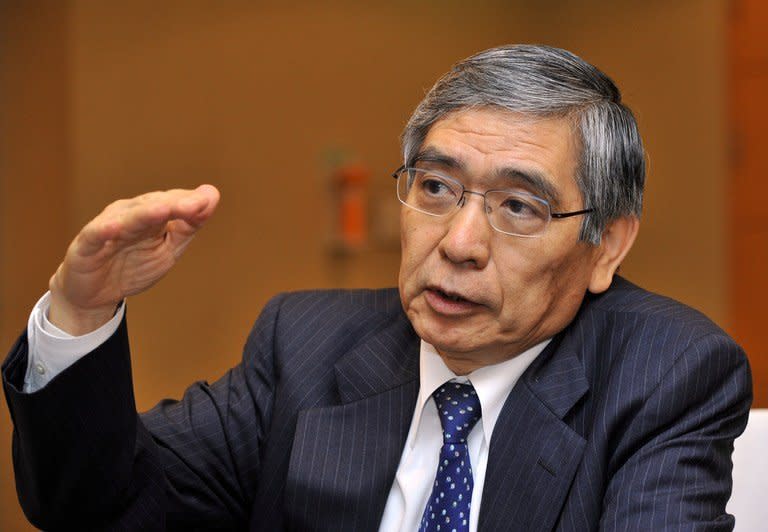

The Bank of Japan's new governor Haruhiko Kuroda on Thursday pledged "all-out efforts" to rid Japan of growth-sapping deflation as gloomy new trade data underlined the scale of the task ahead. Kuroda, a finance veteran who supports aggressive monetary easing, told Prime Minister Shinzo Abe he would do his best to revive the world's third-largest economy. "I said that I will make all-out efforts... to pull Japan's economy out of deflation," Kuroda said after a morning meeting with the premier. The 68-year-old former Asian Development Bank president conceded there would be "difficulty ahead" in rebooting Japan's economy and reversing years of falling prices that have crimped private spending and corporate investment. But "we must achieve it and I believe it can be achieved", Kuroda told reporters at his first official press briefing on Thursday evening. The Oxford university graduate declined to say if he would call a rate-setting policy board meeting before the next scheduled meeting in April. The yen strengthened against the dollar and euro after his comments disappointed expectations of imminent easing measures. "I know emergency meetings have been held in the past so it is not impossible," Kuroda said. The government and central bank have faced criticism overseas, particularly in Europe, that they engineered a decline in the yen in recent months through monetary policy, risking setting off a global currency devaluation war. Kuroda denied those claims Thursday, saying "monetary policy is not meant to target forex rates, which are affected by many factors". Kuroda is a longtime critic of the Bank of Japan, saying it has been too timid in its approach to fuelling economic growth. But he has hailed a two-percent inflation target aimed at tackling deflation -- seen as more explicit than a previous "goal" -- adopted by the central bank's previous chief in January. The BoJ's then-chief Masaaki Shirakawa, under heavy pressure from the government, also announced an unlimited easing programme to start from next year. Abe swept December elections on a pledge to revive Japan's economy with a mix of big spending, aggressive monetary easing and job creation programmes, a package widely dubbed "Abenomics". The premier's prescription won approval from Nobel prize-winning economist Joseph Stiglitz on Thursday after he met Abe in Tokyo. The combination of "monetary policy, fiscal policy and a growth strategy, I think, is exactly right", the professor at New York's Columbia University was quoted by Japanese media as saying. On Tuesday outgoing central bank governor Shirakawa acknowledged he had failed to vanquish stubborn deflation. But he warned that easing measures alone would not restore Japan's former glory, pointing to the need for deregulation and for a reduction in Tokyo's massive public debt. Shirakawa, 63, left the job three weeks before the end of his term after sparring over monetary policy with Abe, who previously threatened to rein in the BoJ's independence if it did not fall in line with his policy views. Earlier Thursday, the finance ministry said Japan logged an $8.1 billion trade deficit in February as exports to key markets China and Europe sagged, while imports jumped nearly 12 percent as Tokyo's energy bills soared. "The data highlight the need for more aggressive easing in Japan from a revamped BoJ," said Chris Tedder, research analyst at Forex.com in Sydney. Japan's increasing reliance on pricey fossil fuel imports in the aftermath of the nuclear disaster at Fukushima in 2011 has reversed its usual trade surplus.
