
King Richard III's skeleton found under English carpark
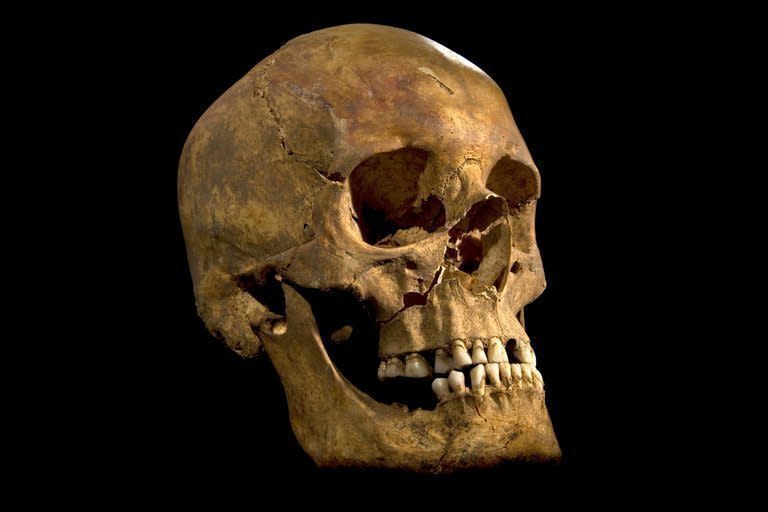
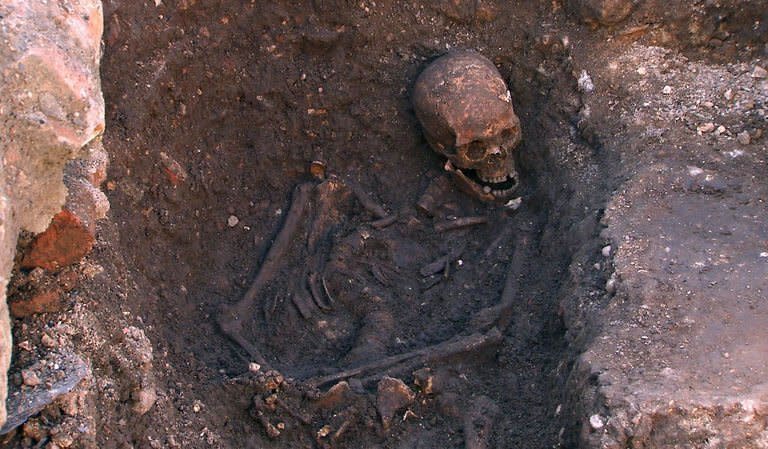
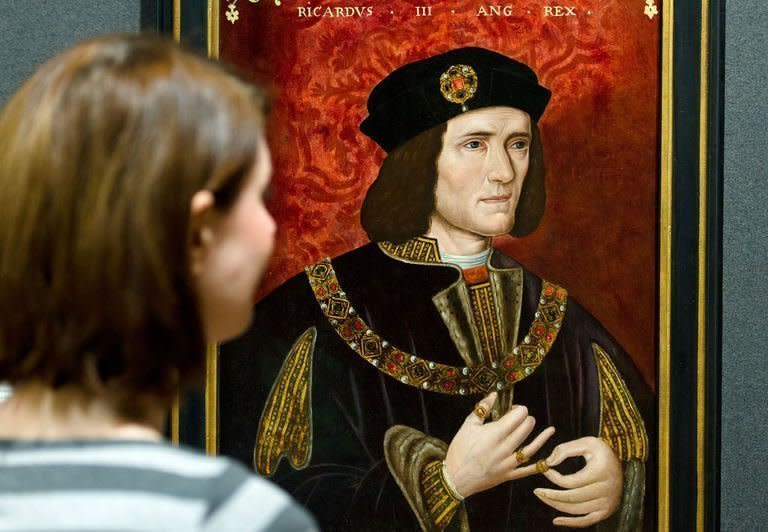

Scientists confirmed Monday that a skeleton found under a carpark in the English city of Leicester was that of King Richard III, in a bizarre end to a 500-year-old historical mystery. DNA from the bones matched that of descendants of the king's sister, while the skeleton had the twisted spine and battle injuries consistent with contemporary accounts, said researchers from the University of Leicester. The remains of the monarch -- depicted by William Shakespeare as a monstrous hunchback and often viewed as one of English history's greatest villains -- will now be solemnly reburied in the local cathedral. "Ladies and gentlemen, it is the academic conclusion of the University of Leicester that, beyond reasonable doubt, the individual exhumed at Greyfriars in September 2012 is indeed Richard III, the last Plantagenet king of England," lead archaeologist Richard Buckley said, to cheers and applause at a press conference at the university. The discovery has caused huge excitement among historians, as it provides firm evidence about a monarch whose life has been shrouded in controversy since his death at the Battle of Bosworth in 1485. According to historical accounts, Richard's body was transported naked and bloody on the back of a pack horse to Leicester before being buried in an unmarked grave at Greyfriars, a Franciscan friary in the central English city. The crown passed from the Plantagenet dynasty to the Tudor monarchs who painted Richard as a deformed villain who stopped at nothing in his quest for power, even murdering his two young nephews -- the so-called Princes in the Tower -- to secure the throne. The hunt for his body began in earnest in 2012 when archaeologists working on historical accounts and geographical clues started to dig beneath the municipal carpark on the spot where Greyfriars was, and found the skeleton. On Monday the research team said the skeleton confirmed that the monarch had severe scoliosis, or twisting of the spine. It may have been painful and caused his right shoulder to appear higher than his left, but there was no evidence of the withered arm depicted in Shakespeare's "Richard III". In a forensic search that at times resembled a television crime drama, and which even one of its supporters admitted was a "one-in-a-million shot", the evidence that the remains belonged to Richard quickly stacked up. The man was the right age -- Richard died aged 32 -- had a high-protein diet consistent with someone of high birth, and had a slender, almost feminine build, which matched contemporary accounts. Carbon dating put the skeleton in Richard's era, while it also showed clear signs of having been in battle. It had two significant wounds to the skull, likely caused by a sword and a halberd, a type of axe, one of which killed him, according to Jo Appleby, the project's lead osteologist. There was also evidence of "humiliation injuries" to the face and buttocks, which may well have been inflicted on his naked body by rivals after his death. The researchers were confident they had found Richard, but the final confirmation only came with the DNA results on Sunday, just hours before more than 150 journalists were due to gather for the announcement. Geneticist Turi King had confirmed that the skeleton's DNA matched that of two descendants of Richard's sister, Anne of York -- a Canadian-born carpenter, Michael Ibsen, and another person who wishes to remain anonymous. "In short the DNA evidence points to these being the remains of Richard III," she told the press conference. Ibsen, a 17th-generation descendant, told AFP he was "stunned" by the discovery and said he was looking forward to seeing the facial reconstruction of Richard, although he added: "It won't look like me." Buckley said the king's remains would now be re-interred at Leicester Cathedral, just across from the carpark, in keeping with archaeological practice to bury remains on the nearest consecrated ground. The decision comes despite calls for them to be buried in the northern city of York, Richard's power base. Historians now hope to dispel some of the myths about Richard, publicising evidence to refute claims that he killed the two young princes and focusing on what he achieved in his brief two-year reign, including the establishment of a system of bail and legal aid. Philippa Langley, a member of the Richard III Society who coordinated and helped fund the search, said she hoped a new image would emerge of the king and "the two-dimensional character devised by the Tudors will be no more". "We have searched for Richard and we have found him. Now it's time to honour him," she said.
