
Obama eyes deeper reform on historic Myanmar visit


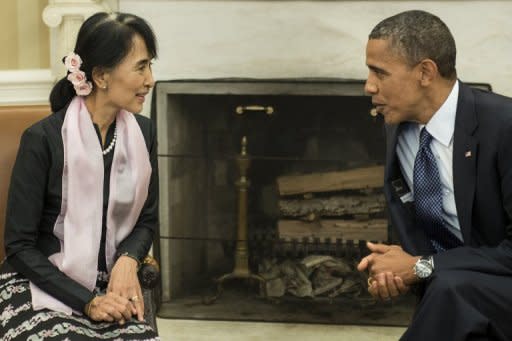
US President Barack Obama will endow Myanmar's startling reform drive with his newly replenished political prestige Monday, as he makes history in a short, but hugely symbolic, visit to the country. Thirteen days after he was re-elected, Obama will become the first sitting US president to visit the formerly isolated state, hoping to spur greater reform and to highlight a rare success for his policy of engaging pariah regimes. But his mission is not without peril: should Myanmar's new political dawn darken and conservative forces move to regain control, Obama's trip could appear in hindsight as premature and invite a domestic political backlash. Obama, who first flies into Thailand on Sunday for a night, hopes to solidify the political reforms of President Thein Sein by granting the Myanmar leader his highest profile moment on the world stage since his nominally civilian government replaced outright military rule. "I want to be very clear that we see this visit as building on the progress that the Burmese government has made," said Ben Rhodes, a US deputy national security advisor. Washington still refers to Myanmar as Burma. "We are going in part to encourage them to continue down that road, because much more needs to be done within Burma to realise the full potential of its people." After meeting Thein Sein, Obama will visit the rickety home of Aung San Suu Kyi, where his fellow Nobel peace laureate was confined for years of house arrest by the paranoid and repressive junta. Obama was deeply impressed by Suu Kyi during their private meeting in the Oval Office in September, and told aides the National League for Democracy leader lived up to her billing. But there will be an air of incongruity when Air Force One touches down and Obama's armoured motorcade rattles through Yangon's decrepit streets, in the shadow of the gleaming, golden spire of the Shwedagon Pagoda. The fact Obama will be there at all is testament to the pace and depth of a reform drive that took American officials by surprise, after they spent years isolating the country's ruling generals through sanctions. "It's a bit risky for the president to go," said Michael Green, a former Bush administration specialist on Southeast Asia, now with the Center for Strategic and International Studies. "This (reform) is not irreversible," he said, adding that Obama's visit was not a "victory lap" but designed to encourage wider change. For some US-based human rights groups, the visit is coming too soon in a reform process that has left the cards overwhelmingly stacked in favour of the military in the country's new parliament. Myanmar watchers also say the future of reforms faces a serious threat from the country's intractable ethnic insurgencies and deadly communal unrest in the West. Euphoria over Myanmar's emergence from decades of junta rule has been tempered by concern over the persecution of the Rohingya, a Muslim minority group in Rakhine state who are widely seen as illegal immigrants to the country. Rights groups have criticised Thein Sein for a military crackdown in the region and accused Suu Kyi of staying mute on the highly-contentious issue. Washington is concerned that unrest in Rakhine, and other festering ethnic conflicts in Shan and Kachin states, risk undermining hopes of stability. Obama's remarks on the Rohingyas will be closely watched, as he gives a speech at a hurriedly spruced up Rangoon University, in veiled homage to the cradle of 1988 student-fuelled protests that were brutally crushed by the junta. The White House is calibrating the symbolism, after deciding not to stage the Obama visit in Naypyidaw, the new capital constructed by the junta, in what would have been seen as an endorsement of the military. Senior White House officials say the impetus for a closer relationship with Myanmar initially came from Yangon after years in which the pariah state had looked to China for support. In response Obama has eased sanctions and dispatched a US ambassador to Yangon and US corporations are now keenly eyeing Myanmar's virgin market. For Washington, there are plenty of upsides to Myanmar exiting the geopolitical deep freeze, as it pivots US foreign policy towards Asia as a counterpoint to China's influence in the region. Daniel Twining, an analyst with the German Marshall Fund of the United States, said there were "multiple wins" for Washington if Myanmar's emergence is sustained.
